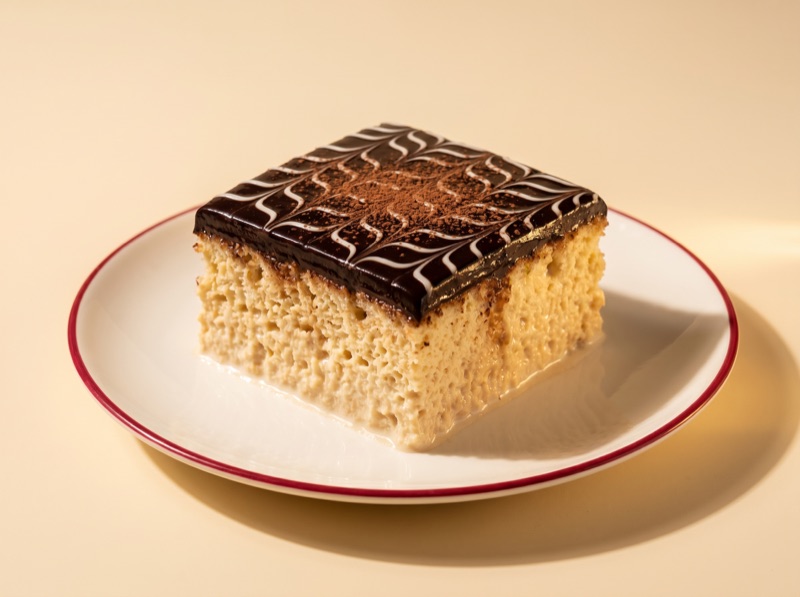
It looks deceptively plain: a square of pale sponge sitting in a shallow pool of milk, a soft cap of cream on top, maybe a dusting of cinnamon or a spoon of fruit. Then you taste it and understand the fuss. So, what is tres leches? In one line: a light sponge cake soaked in three milks until it is wet, cold and rich, then topped with whipped cream. It is one of the great desserts of Latin America, and it is the original behind the viral trilece.
We bake the whole milk-cake family at Ruma (formerly De Beste Lekkernij), a Mediterranean bakery in the Nine Streets in Amsterdam, so we make this a lot. Here is everything worth knowing, minus the recipe-blog padding.
What is tres leches, exactly?
Tres leches means "three milks" in Spanish. You start with a light, airy sponge, the kind built on whipped eggs, baked just until set. Its whole job is to soak. Once cooled, you pour over a blend of three milks and let the cake drink it all in, usually overnight. The result is dense and moist, almost custardy, but it still holds on the fork. A layer of lightly sweetened whipped cream goes on top, and that is essentially it.
The three milks
The classic trio is whole milk, evaporated milk and condensed milk, often loosened with a little cream. Each does a job: whole milk for body, evaporated for a gentle cooked note, condensed for sweetness and richness. Together they turn a simple sponge into something that tastes far more luxurious than the ingredient list suggests.
What is tres leches made of?
- The sponge. Light and eggy, whisked for air, baked until just set. The lighter the crumb, the more milk it holds.
- The three-milk soak. Whole, evaporated and condensed milk, sometimes with cream, poured over and left to absorb.
- The topping. Whipped cream, usually, and often fresh fruit, a dusting of cinnamon, or a drizzle of caramel.
That simplicity is the point. There is nowhere to hide. A good tres leches lives or dies on its milk balance and the freshness of the cream.
Where does tres leches come from?
Tres leches is firmly Latin American, beloved across Mexico, Nicaragua and much of Central and South America, where it is a birthday and celebration staple. Its exact origin is debated, but condensed and evaporated milk recipes printed on tins in the early twentieth century helped spread it widely. From there it travelled the world, and in the Balkans and Turkey it picked up a caramel top and a new name: trilece.
Tres leches vs trilece: what is the difference?
They are the same idea with a different accent. Both are sponges soaked in three milks. The big tell is the topping: tres leches is finished with whipped cream and often fruit, while trilece is topped with caramel and tends to be a touch lighter and less sweet. We wrote a full trilece vs tres leches comparison, and a what is trilece explainer for the other side of the family.
What does tres leches taste like?
Cold, milky and soft, with the cream keeping it light on top despite the richness underneath. Because it is served chilled, it reads as refreshing rather than heavy, which is why people are always surprised by how easily a slice disappears. It takes flavours well, too. At Ruma we rotate raspberry, caramel, pistachio, chocolate and more through the week. See what is on today on the menu.
How do you eat tres leches?
With a fork, cold, straight from the fridge. Scoop up some of the milk that pools on the plate with each bite rather than leaving it behind, that is the best part. It pairs beautifully with a strong coffee, the bitterness cutting through the milk. It is equally good as a finish to a meal or a mid-afternoon pick-me-up.
Common tres leches mistakes
For a cake with so few parts, there is a lot to get wrong. The most common error is a sponge that is too dense or too buttery, which cannot drink the milk properly and turns gluey instead of light. The second is the soak itself: too little and the cake is dry, too much and it falls apart into mush. Timing matters too. The milk needs hours, ideally overnight, to penetrate evenly, so a rushed tres leches is wet on top and dry in the middle. And the cream should be lightly sweetened, because the soak is already rich. Get those right and the rest looks after itself.
Tres leches around the world
Because it travelled so widely, tres leches has dozens of regional faces. In Mexico it is a birthday and fiesta staple, often crowned with fruit. In Nicaragua it is close to a national dessert. Across the Balkans and Turkey it became trilece, with its caramel top. You will find versions with a coffee soak, a chocolate soak, a dulce de leche layer, or a splash of rum or sherry in the milk. The base idea, a sponge made luxurious by milk, is endlessly adaptable, which is exactly why it spread across continents and keeps reappearing in new forms.
How we make ours
At Ruma we keep the soak generous and the sponge light, so the cake sits properly between cake and custard. Rather than the traditional cream-and-fruit finish alone, we rotate flavours through the week so there is always a reason to come back: raspberry, caramel, pistachio, chocolate and more. It is the same family as our viral trilece, made side by side, so you can taste the difference between the cream-topped and caramel-topped versions in one visit. For that comparison in detail, see our trilece vs tres leches guide, and for the city-wide picks our best tres leches in Amsterdam roundup.
Where to try tres leches in Amsterdam
We bake it fresh at Ruma, in the Nine Streets (De 9 Straatjes) at Herenstraat 24A, a short walk from Amsterdam Centraal, Dam Square and the Anne Frank House. For the full city rundown, see our best tres leches in Amsterdam guide. Come find us any day, or order it to your door.