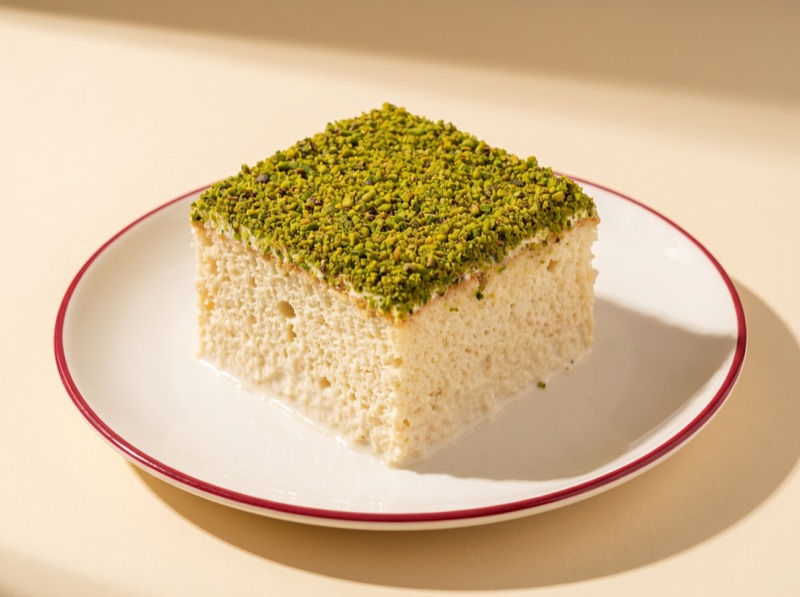
You have probably seen it before you knew its name. A pale, soft slice sitting in a shallow pool of milk, a thin caramel top, a fork going straight through it like it is barely holding together. So, what is trilece? In one line: a light sponge cake soaked slow in three milks until it sits somewhere between cake and custard, then finished with caramel. It is creamy, cold, and not too sweet. And right now it is one of the most filmed desserts on the internet.
We bake it every morning at Ruma (formerly De Beste Lekkernij), a Mediterranean bakery in the Nine Streets in Amsterdam, so we have strong feelings about getting it right. Here is everything worth knowing, minus the recipe-blog life story.
What is trilece, exactly?
Trilece (also spelled trileçe) is a milk-soaked sponge cake. You start with a light, airy sponge, the kind made by whipping eggs and sugar until they hold air. That sponge is there to do one job: soak. Once it is baked and cooled, you pour over a blend of three milks and let it drink everything in. The result is dense and wet in the best way, almost pudding-like, but it still holds its shape on the fork.
The name gives away the maths. It comes from the Spanish tres leches, meaning "three milks". The three are usually whole milk, evaporated milk and condensed milk, often loosened with a little cream. Each one does something different: whole milk for body, evaporated for a cooked, slightly caramel note, condensed for sweetness and richness. Together they turn a plain sponge into something that tastes far more luxurious than its ingredient list suggests.
How to say it
Trilece is pronounced roughly "tree-leh-che", three quick syllables. It is easy to muddle with tres leches, which is the Spanish original and sounds more like "trace lay-chess". Same family, different accent. More on that below.
What is trilece made of?
Strip it back and trilece is four simple layers, each one earning its place:
- The sponge. Light and eggy, whisked for air, baked just until set. The lighter the crumb, the more milk it can hold.
- The three-milk soak. Whole milk, evaporated milk and condensed milk, sometimes with cream. Poured over the sponge and left to absorb, usually overnight.
- The cream. A thin layer of lightly sweetened whipped cream across the top, smooth and cool.
- The caramel. A glossy caramel finish over the cream. This is the signature. It is what separates the Balkan and Turkish version from its Latin cousin.
That is it. No fondant, no architecture, nothing to hide behind. A good trilece lives or dies on its milk balance and the quality of that caramel, which is exactly why it is harder to make well than it looks. Done badly it is a wet, oversweet brick. Done well it is light, cold and gone in four bites.
Where does trilece come from?
This is where it gets interesting, and a little contested. The dessert ultimately traces back to Latin America, where tres leches has been a staple for generations. The most-told origin story is that Latin American soap operas became huge in Albania, local cooks reverse-engineered the cake they kept seeing on screen, and from there it spread through the Balkans and into Turkey. Whether or not every detail holds, the through-line is real: a Latin American idea travelled east and got a Balkan and Turkish makeover.
Some accounts push the roots further back, to the Ottoman era and versions made with goat, buffalo and cow's milk. Today Albania and Turkey both proudly claim it, and both make a beautiful version. We are not here to settle that argument. We are here to bake it well. If you want the longer family tree, our guide to the best Turkish desserts in Amsterdam walks through how trilece sits alongside baklava, simit and the rest.
Trilece vs tres leches: what is the difference?
They are cousins, not twins. The bones are the same, a sponge soaked in three milks, but a few things set them apart.
The topping
The biggest tell. Tres leches, the Latin American original, is usually crowned with whipped cream and fruit. Trilece is finished with caramel. That thin caramel layer gives it an almost flan-like edge and a deeper, buttery flavour.
The texture and sweetness
Trilece tends to be lighter and less sweet, with an airier sponge and, often, a heavier hand on the milk soak so it sits a touch saucier. Tres leches is frequently a little denser and richer. Neither is better. They just hit different.
If you want to go deeper, we wrote a full trilece vs tres leches comparison, and a plain-English what is tres leches explainer for the other side of the family.
What does trilece taste like?
Cold, milky, soft, with a caramel note that keeps it from being one-dimensional. The texture is the headline. It is wetter than cake but firmer than pudding, and because it is served chilled it reads as light even though it is rich. People expect it to be sickly sweet from the look of it. It is the opposite. That restraint is why a slice disappears so fast and why nobody stops at one photo.
It also takes flavours well, which is half the fun. At Ruma we keep a classic caramel version going and rotate others through the week: pistachio, raspberry, Lotus, chocolate, tiramisu. Same soaked-sponge base, different top notes. See what is on today on the menu.
How do you eat trilece?
With a fork, cold, straight from the fridge. Because the milk soak can pool a little on the plate, scoop some of that sauce up with each bite rather than leaving it behind. That pool is the whole point. Trilece is not meant to be dry. It pairs beautifully with a strong coffee or a Turkish coffee, the bitterness cutting clean through the milk. It is a finish-a-meal dessert and a mid-afternoon-pick-me-up in equal measure.
Why did trilece go viral?
It films well, and it tastes better than it films. The jiggle, the fork-through-the-middle shot, the caramel top catching the light: it was built for a phone screen. But the reason it kept spreading is that the real thing actually delivers. Plenty of viral desserts are all photo and no flavour. Trilece is one of the few that earns the hype in person. If you want the wider scene, here is our roundup of the best desserts in Amsterdam.
Where to try trilece in Amsterdam
This is the part we can speak to plainly. We bake trilece by hand every morning at Ruma, in the Nine Streets (De 9 Straatjes) at Herenstraat 24A, a short walk from Amsterdam Centraal, Dam Square and the Anne Frank House. Our version has pulled over 600 million views online, which is a strange sentence to write about a milk cake, but here we are. It is cold, soft, not too sweet, and made fresh daily.
Come find us in the Nine Streets any day of the week, or get it delivered across the city. Plan a visit or order it to your door. For the full picks across town, see our guide to the best trilece in Amsterdam.