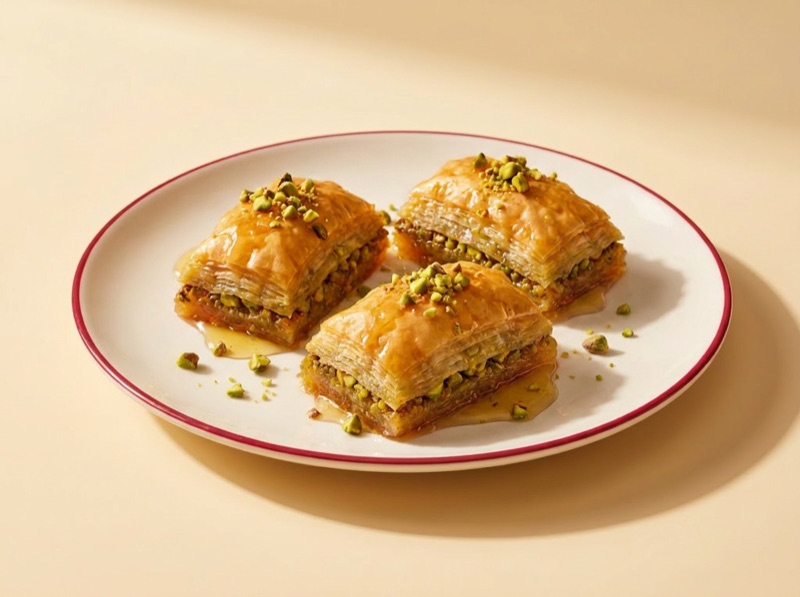
Few desserts reward patience like this one. What is baklava? It is a rich pastry made from many layers of tissue-thin filo, brushed with butter, packed with chopped nuts, baked until golden, then drenched in syrup or honey while still warm so it soaks through and turns glossy. The result is crisp, sticky, nutty and fragrant all at once. It is one of the defining sweets of Turkish and wider Middle Eastern baking, and a good one is a small marvel of technique.
We make it by hand at Ruma (formerly De Beste Lekkernij), a Mediterranean bakery in the Nine Streets in Amsterdam, so we have strong views on what separates a great baklava from a dry, brittle one.
What is baklava, exactly?
Baklava is built from filo (also spelled phyllo), a dough rolled and stretched so thin you can almost read through it. Dozens of sheets are layered up, each brushed with melted butter, with chopped nuts scattered between the layers. The whole tray is cut into diamonds or squares before baking, so the syrup can later seep into every piece. Once it comes out of the oven golden and crisp, warm syrup or honey is poured over, and the contrast between crunch and soak is the entire point.
The syrup soak
This is where baklava is won or lost. Too little syrup and it is dry and dusty. Too much and it goes soggy and cloying. The sweet spot leaves it glossy and moist, the layers still holding a bite. Many versions use a sugar syrup, often scented with lemon or a little water of rose or orange blossom. Ours leans on honey to keep it rich and aromatic rather than flatly sweet.
What is baklava made of?
- Filo pastry: many paper-thin sheets, layered.
- Butter: brushed between the layers for crispness and flavour.
- Nuts: usually pistachios or walnuts, sometimes hazelnuts or almonds, chopped and spiced lightly.
- Syrup or honey: poured warm over the baked pastry to soak through.
That short list hides a lot of skill. Handling filo without tearing it, getting the butter and nut ratio right, and judging the soak are what separate a bakery baklava from a supermarket one.
What does baklava taste like?
Crisp then yielding, buttery, nutty, and sweet but, in a good version, not punishingly so. The honey or syrup carries the flavour while the nuts give it backbone and the filo gives it crunch. Pistachio baklava in particular has a clean, green, almost savoury note that balances the sweetness. It is intense in the best way, which is why it is usually served in small pieces with strong coffee.
Is baklava Turkish, Greek or Arab?
All three traditions, and more, lay claim to it, and the honest answer is that baklava as we know it developed over centuries across the Ottoman world, with roots reaching back to earlier layered-pastry traditions. Turkey, Greece, the Levant and the Balkans all have their own beloved versions, differing in nuts, syrup and spicing. We are not here to settle that. We make a Turkish-style, honey-soaked, pistachio-forward version and let it speak for itself. For the wider family, see our best Turkish desserts in Amsterdam guide.
How to spot a good baklava
- It should look glossy, not dry or pale.
- The layers should hold together and still give a faint crunch, not collapse into mush.
- The nuts should be generous and fresh, not sparse or stale.
- It should be sweet but balanced, with the nut and butter flavours coming through.
Baklava nut by nut
The nut is where regional baklava really diverges. Pistachio, especially the prized green pistachios of Gaziantep in southern Turkey, gives the most celebrated version: clean, vivid and slightly savoury against the syrup. Walnut is the common choice across much of Turkey, the Balkans and the Levant, earthier and more robust. Hazelnut turns up in parts of Turkey near the Black Sea, where hazelnuts grow. Almond features in some Greek and Levantine versions. The spicing shifts too: a little cinnamon or clove in some traditions, rose or orange-blossom water in the syrup elsewhere. Ours leans pistachio, which we think is baklava at its best.
How to store baklava
Good news for gifting: baklava keeps well. Stored at room temperature in a container that is not fully airtight, it stays good for several days and often a week or more, because the syrup acts as a preservative. Do not refrigerate it if you can avoid it, as the cold dulls the flavour and can make the filo lose its crispness. If you must chill it, let it come back to room temperature before eating. This keeping quality is exactly why a box of baklava is such a practical, generous gift, and why it is a fixture of celebration tables.
Baklava around the world
Few desserts are claimed by so many cultures, and the rivalry is real. Turkey, Greece, Armenia, Iran, the Levant, and much of the Balkans all have proud baklava traditions, each convinced theirs is the original. The truth is that layered, nut-filled, syrup-soaked pastries developed and spread over a very long time across the Ottoman and earlier empires, so it belongs to a whole region rather than one nation. Rather than join that argument, we just try to make a very good one. For where it sits among the wider Turkish canon, see our best Turkish desserts in Amsterdam guide, and for the city picks our best baklava in Amsterdam roundup.
Where to try baklava in Amsterdam
Amsterdam does not have a baklava shop on every corner, so a freshly made one is worth seeking out. We bake ours by hand at Ruma, in the Nine Streets (De 9 Straatjes) at Herenstraat 24A, a short walk from Amsterdam Centraal, Dam Square and the Anne Frank House. Pistachio is the move, with a Turkish coffee. See the best baklava in Amsterdam guide, browse the menu, or order across the city.