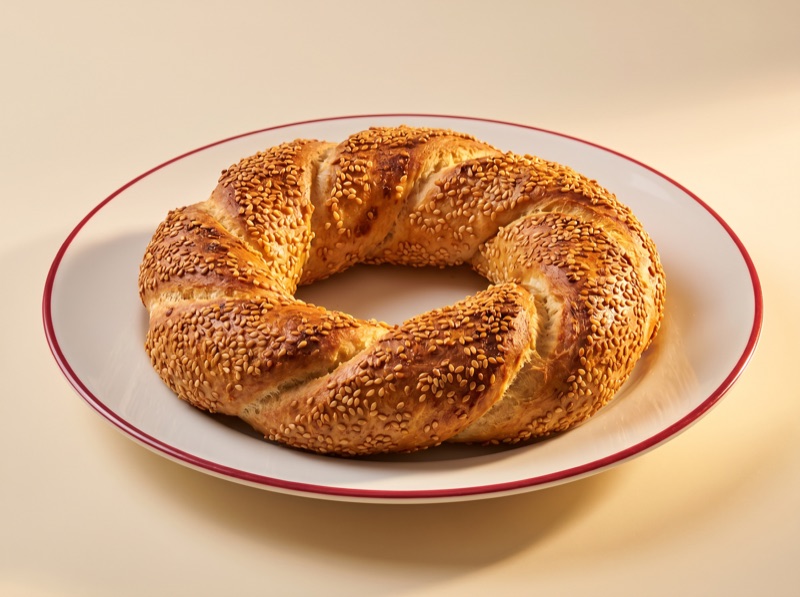
If you have ever walked through Istanbul, you have seen it: red carts stacked high with rings of sesame bread, sold to commuters by the thousand before work. That is simit. So what is simit? It is a circular Turkish bread, crusted all over with sesame seeds, crisp on the outside and soft and chewy within. Think of it as Turkey's answer to the bagel, though the two are cousins rather than twins. Here is the full story, and where to eat a proper one in Amsterdam.
We bake it every morning at Ruma (formerly De Beste Lekkernij), a Mediterranean bakery in the Nine Streets, so this is bread we care about getting right.
What is simit, exactly?
Simit is a ring of leavened wheat dough, traditionally dipped in a water-and-molasses mixture before baking, then rolled generously in sesame seeds. The molasses dip is the secret: it gives the crust its deep golden colour, a faint sweetness, and helps the sesame stick in a thick, even coat. Baked hot, the outside turns crisp and toasty while the inside stays light and tender.
Simit vs the bagel
People reach for the bagel comparison, and it is a fair starting point: both are ring-shaped breads. But a bagel is boiled then baked, giving it a dense, chewy interior. Simit is dipped in molasses, not boiled, and rolled in far more sesame, so it is lighter, crisper and nuttier, with a thinner crumb. Different textures, different jobs.
What is simit made of?
- Dough: wheat flour, water, yeast, a little salt and sometimes a touch of sugar.
- The dip: diluted grape or date molasses (pekmez), which colours and lightly sweetens the crust.
- The coating: a thick, even layer of sesame seeds, toasted in the bake.
That is the whole list. Like a lot of great Mediterranean bakes, simit is simple ingredients done with care. The quality is all in the freshness and the bake.
How do you eat simit?
Traditionally, simit is street food, eaten plain and warm, often with a glass of Turkish tea. In Turkey it is a breakfast and all-day snack, sometimes split and spread with cheese, jam or chocolate-hazelnut spread. It also makes an outstanding sandwich, which is our favourite way to serve it. At Ruma we fill warm simit with crispy tuna, smoked salmon, Italian carpaccio or mozzarella caprese, the sesame crust adding nuttiness and crunch to every bite. See the menu for the current line-up.
Is simit sweet or savoury?
Mostly savoury, with the faintest hint of sweetness from the molasses dip. That balance is what makes it so versatile. Plain, it leans bread-and-sesame savoury. Split with cheese, it is a savoury snack. With a little jam or spread, it edges sweet. It is one of those breads that fits any time of day.
Where does simit come from?
Simit has been part of Turkish life for centuries. Records of sesame bread rings in Istanbul go back to the Ottoman era, and it has been a staple of the city's streets ever since, sold from the familiar red carts. Versions appear across the Balkans and the eastern Mediterranean under different names, but it is most strongly associated with Turkey, and with Istanbul in particular.
Simit and the wider Mediterranean table
Simit sits alongside the rest of the Turkish bakery canon, the baklava, the lokum, the milk cakes. If you want the sweet end of that table, our best Turkish desserts in Amsterdam guide covers it, and our best Mediterranean food in Amsterdam guide places simit in its savoury context.
Simit through the day in Turkey
In Turkey, simit is woven through the whole day, not just breakfast. The red carts (the simit sarayi sellers and the street vendors) start early, feeding commuters on their way to work. Mid-morning it is a snack with tea. At lunch it becomes a quick, cheap meal, often split and filled with cheese or kasar. In the afternoon it reappears alongside the endless glasses of black tea that fuel Turkish social life. It is the great democratic food of the Turkish street: cheap, everywhere, and eaten by everyone from schoolchildren to office workers. That all-day versatility is exactly why it makes such a good bakery staple far from home.
How simit is made
The method is what gives simit its character. The dough is made, divided and rolled into long ropes, which are then twisted, usually two strands together, and joined into a ring. Each ring is dipped first in water mixed with grape or date molasses, then pressed into a bed of sesame seeds so it picks up a thick, even coat. Then it bakes hot and fast. The molasses caramelises in the oven, giving the deep colour and faint sweetness, while the twist gives simit its slightly chewy, layered crumb. It is simple in ingredients but precise in execution, which is why a freshly made one is so much better than a packaged version.
Simit beyond Turkey
Ring-shaped sesame breads appear all around the eastern Mediterranean and the Balkans under different names and slightly different recipes, a reminder of how far these food traditions travelled across the old Ottoman world. But simit, with its molasses dip and heavy sesame coat, is most strongly tied to Turkey and to Istanbul in particular. Bringing it to Amsterdam, freshly baked, is our way of putting a genuine piece of that street-food culture on the table here. For where it sits among the rest of the cuisine, see our best Mediterranean food in Amsterdam guide.
Where to try simit in Amsterdam
We bake simit fresh every morning at Ruma, in the Nine Streets (De 9 Straatjes) at Herenstraat 24A, a short walk from Amsterdam Centraal, Dam Square and the Anne Frank House. Have it plain with a coffee, or as a sandwich. Come find us any day, see the best bakeries in Amsterdam guide, or order across the city.